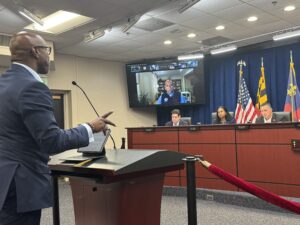
Ranked Choice Voting Maryland (RCVMD) is a 501(c)3 nonprofit dedicated to fostering better elections and a more robust democratic process across the state. Our candidate survey is an opportunity connect with candidates on important democracy solutions.
Survey responses will be shared publicly and distributed to our 5000 supporters prior to the election. We do not endorse candidates for office.
The candidate survey is closed.
The survey was open to all candidates running for public office in Maryland.
For more information, reach out to Michelle Whittaker, michelle@rcvmd.org.
Survey Responses
Maryland Primary (2026)
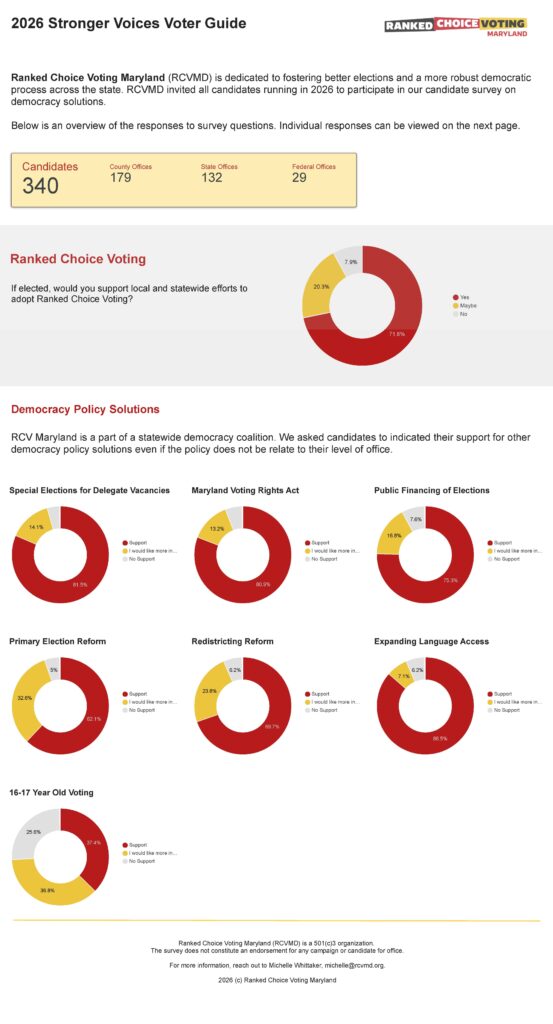
RCVMD received responses from 341 candidates across Maryland running for county, state, and federal offices.
Download candidate responses (PDF).
City of Annapolis (2025)
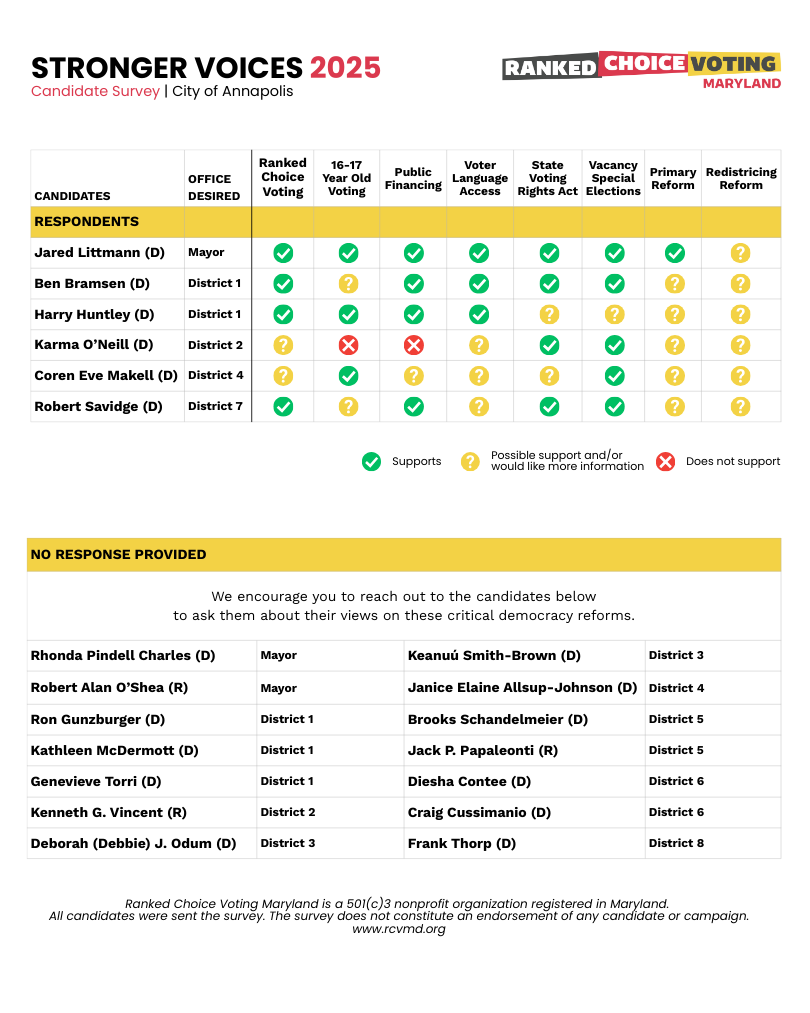
RCV allows voters to more confidently vote for who they WANT to be elected instead of voting in FEAR of who they don’t want to be elected. It gives more freedom to vote for who you feel the best candidate is, regardless of where they may stand in polls.
Ben Bramsen
Alderman Candidate
It is an option to explore. I do believe that the primary should be non partisan in order to give a voice to all eligible voters.
Karma O’Neill
Alderman Candidate
I believe this could engage and educate more voters about local issues as well as the candidates on the ballot.
Coren Eve Makell
Alderman Candidate
It’s a big part of why I got into government. RCV makes elections kinder and fairer.
Harry Huntley
Alderman Candidate
I support ranked choice voting because it gives voters more power and a stronger voice. Instead of choosing just one candidate, voters can rank candidates in order of preference. This ensures that the eventual winner has broad support, not just a narrow plurality.
Jared Littmann
Mayoral Candidate
RCV will help make our democracy healthier. Ensures the victor wins with a majority rather than plurality, discourages vicious attacks from other candidates, and eliminates the spoiler effect.
Robert Savidge
Alderman Candidate
City of Frederick (2025)
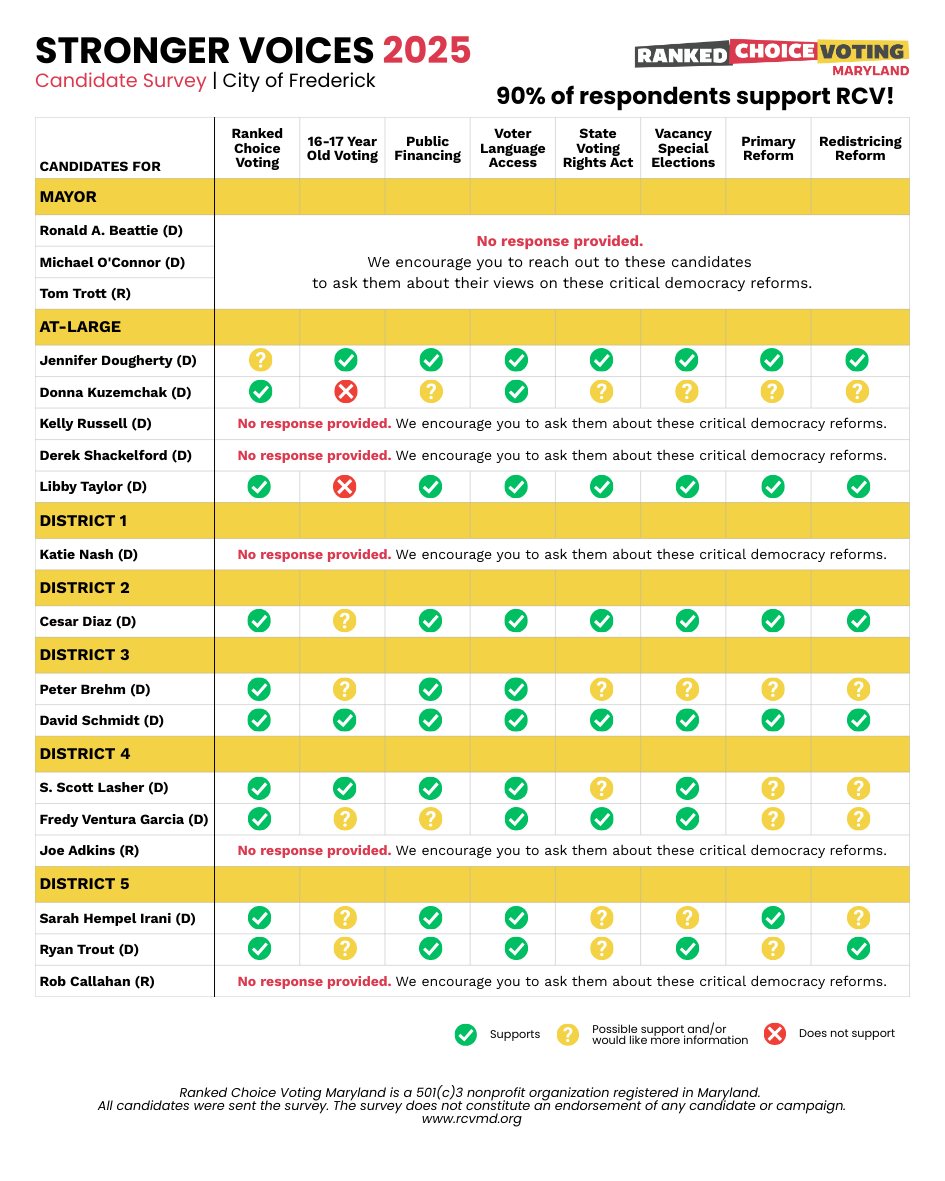
I support ranked choice voting because it gives residents a stronger voice. It ensures every vote counts, reduces negative campaigning, and helps elect candidates who truly reflect the broad support of our community. It’s a fairer, more representative system for Frederick.
Libby Taylor
Council Candidate
The City of Frederick conducted a multi-year effort to reform the elections. The incumbents all chose to adopt Districts and At-Large reform as opposed to RCV. Making another change makes it confusing for voters and does not guarantee more candidates. In this election, only one race – the At-Large race would be impacted. In statewide races, I am not opposed to RCV.
Jennifer Dougherty
Council Candidate
Ranked choice voting empowers voters to rank candidates by preference, vote their conscience without fear of “wasting their vote,” and helps third parties gain validity. It’s a step toward breaking down the two-party system and better reflecting the will of the people.
Sarah Irani
Council Candidate
I believe this could engage and educateThe establishment of City Council Districts was a good first step to allow more direct representation for residents. Ranked Choice voting is the next step to allow individual voters to have their vote carry more weight. This needs to happen in Frederick before the 2029 city elections.more voters about local issues as well as the candidates on the ballot.
Cesar Diaz
Council Candidate
Helps voters elect candidates that are not far right or far left.
Peter Brehm
Council Candidate
It is a more fair way to elect people. I can rank someone a zero or I can rank in the order I prefer.
Donna Kuzemchak
Council Candidate
Simplifies primaries and it seems to be working successfully in the places it’s been implemented.
Fredy Ventura Garcia
Council Candidate
Ranked choice is a tremendous tool to give more power to the community. Our local city representation has, for a generation, all been from one small neighborhood. This is because the Democratic primary has tremendously low nonparticipant, and the district is so significantly D leaning that only the primary matters. That being said, RCV is very different and could be confusing for voters that have never experienced it before. If passed, we will need a significant community effort to educate and train our residents to ensure their voices are heard.
David Schmidt
Council Candidate
When there is no clear majority, the secondary preferences of the voters become important in the creation of a majority.
Scott Lasher
Council Candidate
I support the implementation of ranked choice voting as a way to strengthen our democracy, give voters more voice and choice, and ensure that elected leaders better reflect the will of the people.
In a time when many people feel disillusioned by politics and discouraged by division, ranked choice voting offers a hopeful reform—one that puts more power in the hands of voters and strengthens the legitimacy of our elections. It’s a common sense improvement to our democratic process.
Ryan Trout
Council Candidate